

Sycamore is for informational purposes only. Read my full disclosure here.
As you might already know, The Trade Desk reported their Q2 earnings on Thursday, August 6.
I have been following this company since it IPO’d in 2016. Never have I been more disoriented by an earnings release. A company that has been so consistent, for so long, missed the top-line number by ~5% and missed Q3 consensus guidance by ~24%.
It was a punch to the gut.
I have been bullish on the The Trade Desk as the stock has collapsed over the past year, and have been entirely wrong. To my own dismay.
So with that framing and the stock at an 8-year low, here are some minimally edited speculative meanderings about what is going on here. Please note, these are my personal speculations.

What We Know
Macro challenges: management keeps making this the primary cause of the decline. 25% of total revenue comes from CPG and auto companies. Both have been hit hard by a soft consumer (especially lower income), inflation, higher rates, tariffs, tariff uncertainty, war in the Middle East, fuel costs, and more. Some CPG companies have confirmed this pressure in their own earnings calls. CEO Jeff Green said about half of this category is actually still growing well, while the other half is challenged. Much more on this below.
Competition: we’re really just talking about Amazon here. That said though, TTD and Amazon have fundamentally different objectives as DSP’s. But Amazon is seemingly winning more dollars through cheaper reach, has been more focused on programmatic guaranteed deals and bundling of their own first-party shopper data. TTD has always been premium and will always maintain the effort to be premium (cost and outcome). That said, management suggested that some of TTD’s largest customers, through headwinds, are favoring cheaper reach right now.
Leadership challenges and turnover: companies go through structural change, especially at inflection points. TTD is at their ultimate inflection point. But it has taken time and has been drawn out. This has likely created significant internal uncertainty as leadership has almost been entirely reshuffled and the company has seen turnover across the board. This disrupts relationships for account managers, business development, product upgrades and launches, partnerships, and more. The spot with the most turnover has been the CFO seat. Obviously a company of this size and scale desperately needs an experienced and steady CFO presence. I was encouraged that Olmstead can be that guy after hearing him on the call for the first time.
Platform problems with Kokai: it has been well documented that Kokai had a rough rollout. If you go back to the first leg down this company suffered in February 2025, it had to do primarily with the botched rollout. It seems that not only was the rollout botched, but the platform in general was never really well received. There is plenty of commentary out there, of which I have read ad nauseam, that suggests it is not as smooth and intuitive as you would expect. It is possible this has also hurt spend growth on the platform, as buyers themselves are favoring other platforms out of convenience. Green has been adamant that Kokai is wonderful, but finally capitulated to some degree on the earnings call when he said they would be launching a massive overhaul of the platform to make it simpler and easier to use. This launch will come within the next month, he said.
Building for the long term: while many companies out there are optimizing for this quarter’s result and next quarter’s guidance, TTD is clearly not doing that. Not only have they said over and over that they are not and will not do that, but you can see it on their balance sheet. They are sitting on $1.5B of cash, equivalents, and short term investments, roughly 25% of the entire market cap. If they were optimizing for today they would be spending to maintain organic growth and/or to acquire for inorganic growth. They simply are not doing that.
I think they would also be capitulating on price, and it doesn’t appear they are doing that either. I have always argued the take-rate here is safe and have thus far been correct, despite many sell-side analyst and Substack analysts saying it’s a risk. Here is what Green had to say about it on the call:
“I remember one of the primary presentations that we gave to our own employees was, ‘It is not our goal to be the cheapest platform. It is our goal to be the best.’ That has definitely been our mantra for more than the last decade. …
That said, we’ve always looked at this as if we can grow faster or win more business by changing that price or changing the approach, we’ll always look at it and always consider it.
We tried to do it in a way that it didn’t make it too volatile because we always knew that we could lean on the fact that we were adding more value than we ever cost or extract. We remain really confident in our business model and in our pricing philosophy. …
I don’t think that the net number has to change dramatically because we’re extremely confident that we’re adding more value than we cost.”
It has been a perfect storm of challenges. But I do think there is one more factor at play to consider…
A Publicis Problem?
How did the darling of adtech, the most premium DSP in the industry, collapse so badly?
There has to be an explanation beyond macro challenges and internal execution issues, etc, etc. 2022 brought plenty of its own macro headwinds, inflation, rising rates, Russia/Ukraine war, and growth decelerated from 43% down to 32%. But it decelerated. It didn’t fall off a cliff.
This time, TTD is guiding to a revenue decline. For me, the only way to explain the Q2 miss and the 24% miss on Q3 guidance, is Publicis.
As already mentioned, the business in general is humming along, growing double digits except for half of the CPG/Auto clients. Together these categories make up 25% of the business, so the troubled half works out to about 12% of total revenue (thanks for pointing this out Potential Multibaggers).
If total company growth is sitting at 3% in Q2, and the healthy 88% of the business is genuinely growing double digits, the math only works if that troubled 12% is shrinking by something like 45-50% Y/Y to drag the total revenue number down to 3%.
A whole cohort of business got cut in half.
It was well documented through the fallout in the spring that Publicis was TTD’s largest customer, representing somewhere between 10-15% of total revenue, with some sell-side analysts citing 12% exactly (if memory serves me correctly).
Not only this, but Publicis’ own client roster highlights many of the largest CPG/auto names in the world. P&G, Nestle, L’Oreal, PepsiCo, Unilever, Toyota, Nissan, Volkswagen. These are (were?) all clients of TTD via the Publicis partnership.
Publicis seems to meaningfully represent the category that is getting hammered for TTD and also represents the exact percentage of troubled revenue as a whole. We’re all well versed by now of the TTD/Publicis dispute from March where the holding company accused TTD of wrongly applying certain fees to their clients and took them off their recommended list. This played out through the entirety of Q2 and was resolved in late June although neither TTD nor Publicis really provided any detail, other than that TTD was back to being on the recommended list heading into Q3.
So here’s my question: are the CPG/Auto pains really a Publicis pain? I’m speculating here, but has TTD lost half of its business with Publicis following the March fallout? It seems like it might be so.
Here are three thoughts to try and draw this out further:
1.) In early March, CEO Jeff Green made a $150M purchase of TTD stock for an average price per share of ~$25. He is currently underwater ~50%. At the time, the macro challenges/softness were known, the technology challenges were known, the c-suite turnover challenges were known. So what was Green doing!? What didn’t he know then? Two weeks to the day after Green’s buying spree, one of the largest insider purchases in capital markets history, the Publicis problem hit the PR machine.
2.) Right before the Q2 earnings release, Green went on the debut episode of WPP Media’s (major holdco) new podcast. He sat down with CEO Brian Lesser to declare that TTD is all in (as they have always been) on holdco/agency partnerships. That’s not a coincidence to me. Green and Lesser are friends and Lesser made it a point to call out how great their partnership with TTD is, saying:
“I think trust is the foundation of all great partnerships. I trust The Trade Desk and that you are a great partner to WPP.
I understand you have a business to run, and you have a business funnel associated with your products and services, but we’ve really never had any issue with how you charge because you’re very transparent about that and we’re very expert in how we use your tools and technology.”
Is Green trying to smooth over holdco relationships knowing the carnage coming for his stock? Is Lesser taking a shot at one of their largest competitors?
3.) The other players in the public programmatic market are not collapsing. Viant Technology, a DSP and TTD’s closest public comp, grew revenue 34% Y/Y in Q2 and is guiding to 27% growth in Q3. Amazon’s advertising business, not a perfect comp but instructive, grew 26% in Q2. Not only are they growing extremely well, but growth in Q2 accelerated Y/Y for both.
Again, these aren’t perfect comps, as the companies have different customers, some lean more heavily on programmatic guaranteed deals (cheaper reach), etc. But if the whole ecosystem were under macro pressure the way TTD describes it, you’d expect the pain to show up at least a little more broadly. Instead it’s concentrated in one place.
And if the problem at TTD is one customer, perhaps that spend would go elsewhere? And it looks like that just might be the case based on their accelerating Q2 growth.
So what?
I don’t think TTD is a broken business. I don’t think the DSP model is a broken model. I think TTD has a broken relationship with its largest customer. It’s the only way I can possibly make sense of all this.
But to be honest, as a shareholder, it’s actually encouraging. I believe nearly 90% of the business is growing double digits, but 10% of the business is down 50% and maybe getting worse. But at least, if I’m correct in all this speculation, we can point to a particular problem. At least there is a floor on this indescribable downturn versus an unknown collapse into further unknown.
Will the Publicis relationship come back now that the holdco is recommending TTD again? It’s too soon to tell and we have to live with that uncertainty.
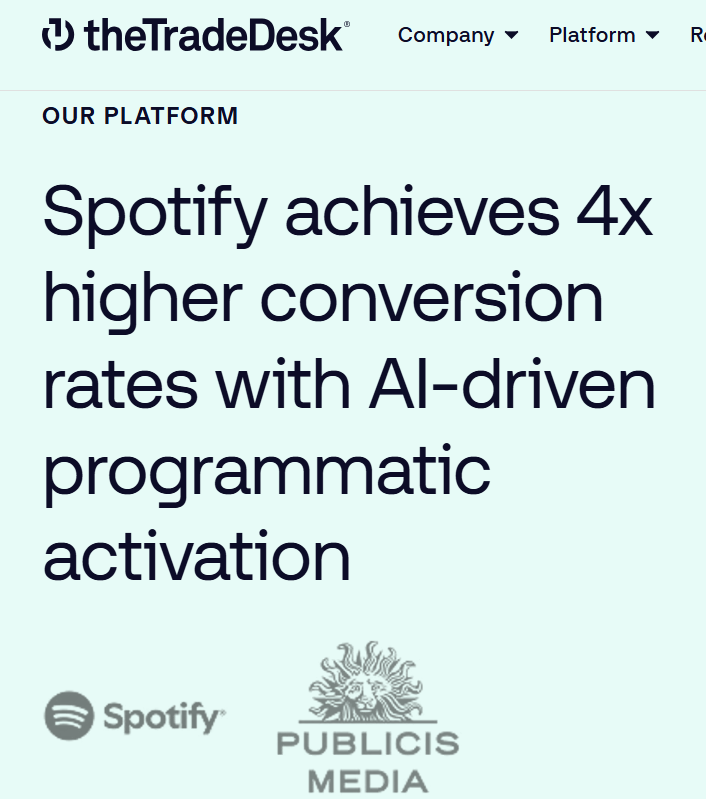
But for now, TTD is certainly making their effort to say things are just fine as they published the following case study this past week in partnership with Spotify and Publicis.
What gives!!
Thanks for reading!
Matthew Blake
Founder & CIO | Sycamore Capital Management, LLC

Disclaimer: Sycamore Capital Management, LLC (referred to in some materials as “Sycamore” or “Sycamore Capital”) is a research and publishing platform provided for informational purposes only. Nothing published by Sycamore Capital Management, LLC or its author constitutes investment advice or a recommendation to buy, sell, or hold any security. The company is not a registered investment advisor and does not manage client assets or offer personalized financial advice. All opinions expressed are solely those of the author, and any securities referenced reflect personal holdings at the time of publication unless otherwise stated. Readers are solely responsible for their own investment decisions and are encouraged to conduct independent research and consult with a licensed financial advisor before acting on any information provided.