
Six Flags Entertainment (FUN) | The Cedar Fair Merger Roller Coaster
Leverage, EBITDA, and attendance updates, plus a new activist, a new CEO, and a $331M sale

Last July, I wrote about Six Flags after the Cedar Fair merger following the first year since the deal was completed. The stock was down nearly 50% from its post-merger peak, leverage sat at an uncomfortable 5.7x, and I drew a loose comparison to the Eldorado-Caesars deal, another highly levered “largest player in its category” merger I’d watched up close during my equity research days. My conclusion then was that I couldn’t get comfortable with the debt load, even if the valuation (10x FCF) was pricing in real execution risk.
I wanted to provide an update one year on from my report and now two years since the closing of the merger. Some of my original questions have answers now while new ones have emerged.
Financial and Operational Scorecard
EBITDA guidance was cut and they still missed. A year ago, management was guiding to $1.08B-$1.12B in adjusted EBITDA for 2025. In September that number was reduced to $860M-$910M, and then reduced again in November. The actual result was $792M, a significant miss of the original forecast. This is a problem for a company whose entire deleveraging plan depends on EBITDA growth outrunning debt paydown.
Leverage got worse. Net debt sits at roughly $5.3B. Against $792M of trailing EBITDA, that’s north of 6x, worse than the 5.6x I wrote about last summer, and further from the “3.0x by 2026” target management had originally pitched as part of the merger rationale. Tellingly, the language from the CFO at the time shifted too. On the Q4 2025 call, the goal was described as getting leverage “below 4x on a sustained basis,” a much softer target than the original goal.
Attendance is still a swing factor. I said a year ago that attendance was the real tell for whether this business could grow into its debt. FY2025 attendance came in at 47.4M guests, flat to slightly down versus the ~48M I cited last year, and still below pre-pandemic norms across the legacy Six Flags parks specifically. The Cedar Fair side of the business continues to outperform the legacy Six Flags parks, which remains an open question I don’t think management has fully answered yet (more below).
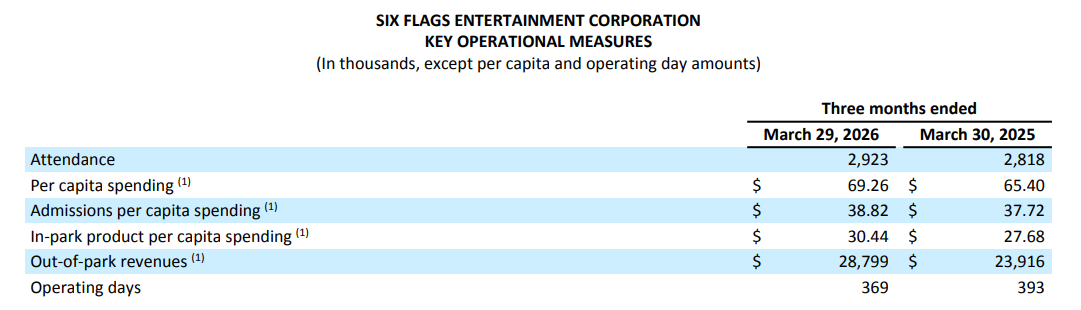
Q1 2026 showed genuine operating improvement. All that said, the most recent quarter was a real step forward. Revenue grew 12% to $225.6M, the adjusted EBITDA loss narrowed by $48M Y/Y, attendance was +4%, per-capita spending +6%, and the company cut $50M (12%) out of operating costs. Liquidity nearly doubled to $462M. If this trend holds through the peak summer quarters, which is when the business makes its money, it would be the first signal that the combined portfolio is starting to work (bringing Six Flags parks up to Cedar Fair’s operating standards).
The stock is a roller coaster. FUN traded as low as $12.51 earlier this year, before recovering to where it trades today for around $17-$18. This is ~60% lower than where the stock was trading when I published the report last year.
Answering My Own Questions
I ended last year’s report with a few open questions. Here are some thoughts on those:
“Can a consumer-facing company with this much leverage execute its way out?” Certainly not within a year. The operational playbook (cost cuts, per-cap growth, disciplined capex toward flagship parks) is showing up in the numbers. But EBITDA delivery has lagged and leverage is higher today than it was when I first raised the concern. The company has a long way to go regarding the balance sheet but the operational improvements is a good start.
“Do they act proactively on asset sales, or wait until the balance sheet forces their hand?” This one has a clear answer, and it was more decisive than I expected. In March 2026, Six Flags agreed to sell seven parks to EPR Properties for $331M in cash. These parks included:
Valleyfair
Worlds of Fun
Michigan’s Adventure
Schlitterbahn Waterpark Galveston
Six Flags St. Louis
Six Flags Great Escape
La Ronde
That’s a much bigger and faster move than the single-park Bowie, MD closure I referenced last year, and it’s a direct validation of the Eldorado/Caesars comparison: sell the long tail to protect the core. Management has noted that roughly 90% of EBITDA comes from just 15 parks, so there’s likely room for further trimming if the market or the balance sheet demands it. That said, management made clear on the most recent earnings call that is not a priority right now.
“What is it about the legacy Six Flags parks that isn’t resonating versus Cedar Fair’s?” Management hasn’t been able to give a fully satisfying answer. The stated strategy is shifting investment away from thrill-ride-only capex and toward food, family offerings, and a more well-rounded guest experience. This is probably the right strategy given the diversity of Cedar Fair parks and the overall positive customer experience. I’d put this at the top of my watch list for the upcoming earnings cycle.
In the remainder of this report, I will look at the new developments that have come about over the past year and how I am thinking about this business for the Sycamore portfolio.
To unlock the remainder of this report, and others like it, consider becoming a paid subscriber.
Sycamore provides in-depth qualitative research on individual stocks and insights into my personal concentrated portfolio giving you actionable ideas for your own investment decisions.